
Building A Modern Customer-Centric Digital Retail Bank
Ensuring Survival and Growth in a Digital World
The future of retail banking is being shaped by rapid technological advancements, evolving customer expectations, and the growing influence of neobanks, fintechs, telecommunications companies, and tech giants. The key to long-term survival lies in placing the customer at the centre of all digital initiatives, ensuring that banking services are intuitive, accessible, and integrated into their everyday life.
What is 'Personalisation'?
Personalisation is at the heart of customer-centricity through listening to customers' needs, understanding their preferences, and delivering timely, relevant tailored solutions. By 2030, as customer expectations for intuitive, individualised experiences grow, banks that fail to personalise will struggle to retain loyalty and drive growth.
Currently, personalisation in retail banking tailors products, services, and communication based on broad customer data like demographics, transaction history, and life stage. It improves relevance but currently remains largely segment-driven. An example would be offering home mortgage promotions to 30 to 45-year-olds based on life stage, pre-filling loan applications with existing customer details, and using preferred communication channels like email or SMS. While improving relevance, these approaches rely on historic data and remain largely static.
Hyper-personalisation goes deeper, using AI, real-time data, and behavioural insights to predict needs and deliver proactive, context-aware experiences. An example includes using real-time data and predictive analytics and AI to deliver instant mortgage pre-approvals when customers browse homes on a real estate partner's website or suggest budgeting adjustments based on spending patterns using open banking to aggregate all current account and credit card transactions or trigger contextual offers like travel insurance after flight bookings using their credit or debit card. These dynamic, predictive interactions enhance engagement by addressing individual needs at the right moment.
The key difference is depth and timing. Personalisation customises offerings, while hyper-personalisation anticipates needs dynamically, improving customer engagement, loyalty, and deposit growth by addressing individual financial goals.
Digital-first Banks are Dominating Customer Satisfaction
Customer satisfaction surveys show traditional banks losing their reputation for excellent service as digital-first banks set new standards. Customers now expect speed, convenience, and personalisation, exposing traditional banks' slow digital transformation. Branch closures and service reductions, outdated systems, and impersonal service have accelerated this shift: they are no longer the informed consumers' first choice. Digital-first retail banks have topped the UK's official bank customer satisfaction survey (conducted by Ipsos on behalf of the Competition and Markets Authority that is displayed on all bank websites and in all branches) for the last 5 years in a row.
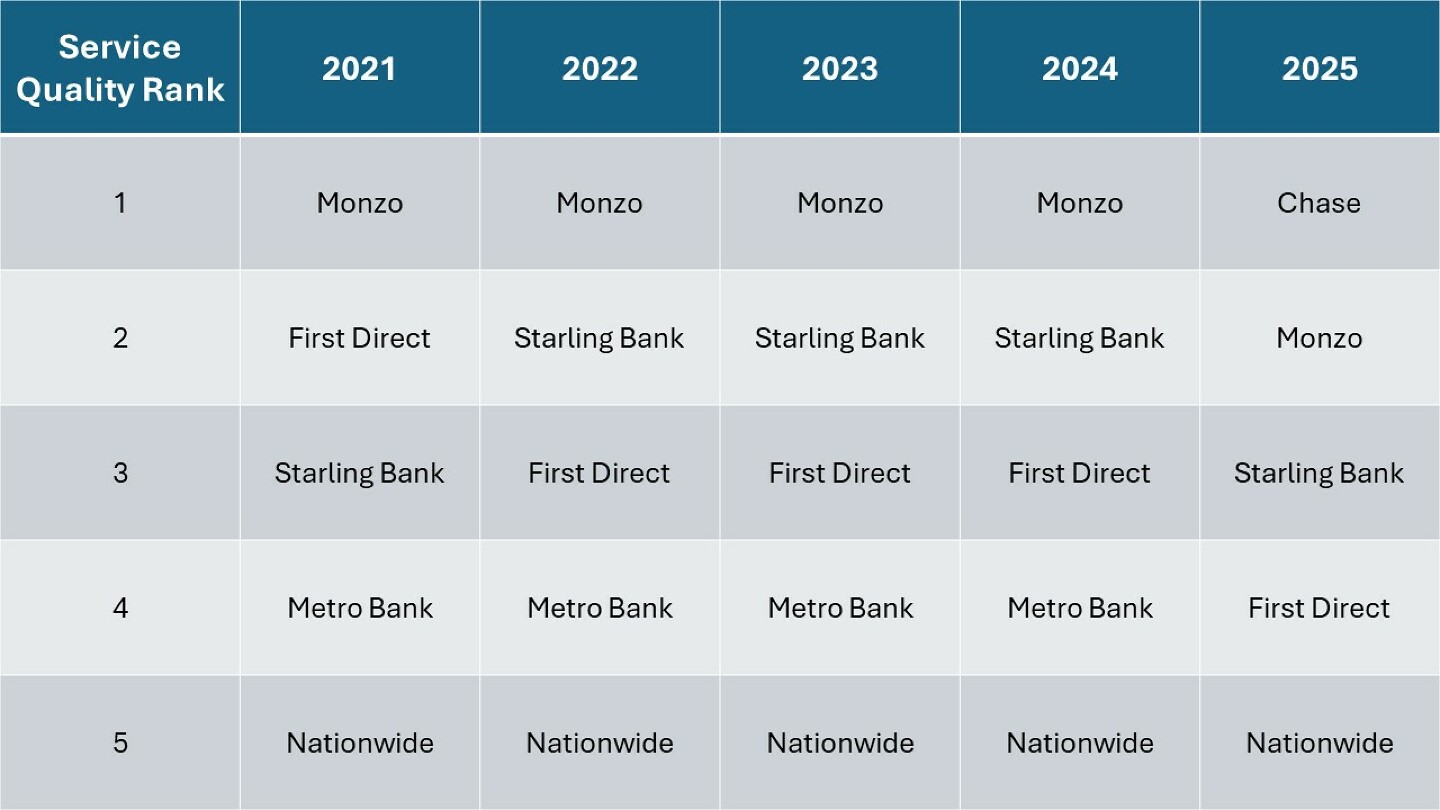
Customer satisfaction with overall service quality is a reliable measure in retail banking as it reflects trust, loyalty, and customer retention. It captures key factors like responsiveness, convenience, and problem resolution, directly impacting engagement, referrals, and revenue.
These digital-first banks are relative newcomers: Monzo launched in 2015, Starling Bank (2016), Chase UK (2021), Metro Bank (2010), and First Direct (digital-first bank, part of HSBC UK) in 1989. By comparison Nationwide (a mutual owned by its members, not shareholders) launched in 1884, and Lloyds Bank in 1794 (ranked sixth place). Other large UK banks, such as Barclays (10), NatWest (11), HSBC (12), and Santander (12) haven't featured in the top 5 since Monzo and Starling Bank were added to the survey of 17 banks in late 2020.
Net customer growth figures show a corresponding trend, with the top 5 in 2025 acquiring more customers than they lost, and the bottom 12 generally losing more than they acquired. This happened despite offering generous monetary incentives to customers who switched their current account from a competitor.
While precise generational data is scarce, anecdotally, the digital nature of Monzo, Starling Bank, and Chase UK suggests they attract a diverse customer base, with a notable emphasis on younger, tech-savvy consumers.
There could not be a clearer warning signal for traditional retail banks.