
Leading A Risk Management Culture
Key Roles in Risk Management
A robust risk management culture requires clearly defined roles and responsibilities with each role playing a critical part in embedding risk awareness into the whole bank's culture, policies, and day-to-day operations. We have focused on key roles, their responsibilities, skills and experience.
Global Regulatory Frameworks
Risk governance structures in banks must align with global, regional and local regulatory frameworks to ensure financial stability, sound risk management, and compliance with best practices. We outline one global, regional and local framework:
- Global: Basel Committee on Banking Supervision (BCBS) Principles for Risk Management. These principles provide a global framework for managing financial risks, including credit, market, operational, and liquidity risks. They emphasise board and senior management responsibilities, risk identification, monitoring, and reporting, as well as the need for a strong risk culture.
- Regional: European Banking Authority (EBA) Guidelines on Internal Governance. These guidelines apply to European banks, focusing on corporate governance, risk control, and accountability. They mandate clear organisational structures, well-defined roles for risk management functions, and comprehensive internal control mechanisms to ensure effective oversight and decision-making.
- Local: US Federal Reserve and Office of the Comptroller of the Currency (OCC) Risk Governance Frameworks. In the United States, these frameworks set expectations for large financial institutions, requiring strong board oversight, independent risk management, and clear risk appetite statements. They emphasise the need for stress testing, scenario analysis, and proactive risk mitigation strategies.
Retail Bank Governance Structure
In this section we will examine a typical governance structure and the key leadership roles that embed a risk management culture.
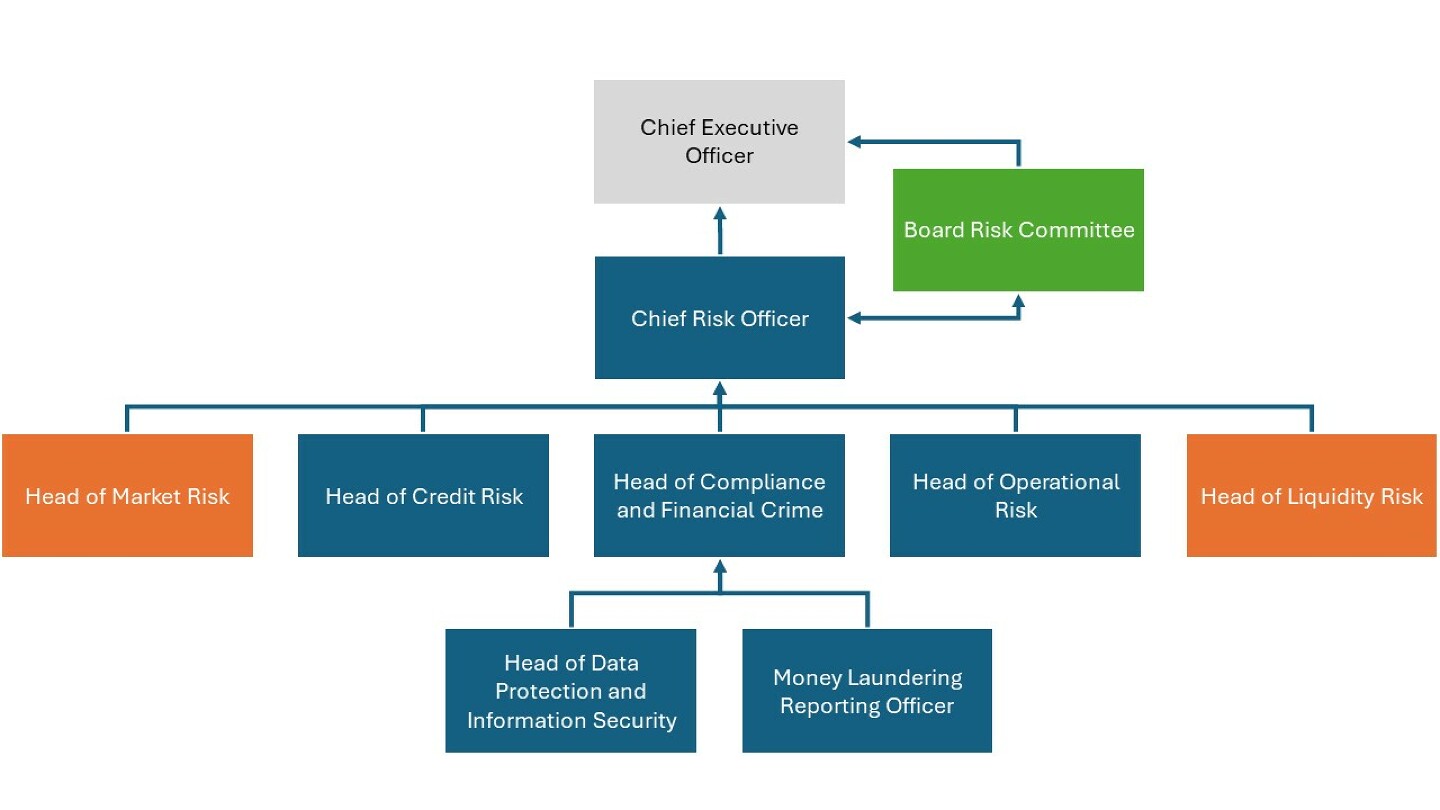
Chief Risk Officer (CRO)
The CRO reports to the Chief Executive Officer (CEO) and leads the development and execution of risk management frameworks, ensuring they align with the bank's overall strategy. They assess enterprise-wide risks, including credit, operational, market, and cybersecurity risks, implementing measures to mitigate potential threats. Additionally, they ensure regulatory compliance, adapting policies to evolving financial regulations. They also advise the bank's board of directors on risk strategy, providing insights into risk trends and recommending proactive solutions to strengthen the bank's resilience.
They must possess strong analytical abilities to assess complex risk scenarios with extensive regulatory knowledge to ensures compliance with local and global laws, while financial acumen helps evaluate market risks. Strong leadership skills enable effective risk governance, and crisis management expertise ensures rapid response to unforeseen threats.
Board Risk Committee
The Board Risk Committee reports to the CEO and is responsible for overseeing the bank's risk management framework, ensuring that risks are effectively identified, assessed, and mitigated in alignment with the bank's strategic objectives and regulatory requirements. The committee works with the CRO and reviews key risk exposures, including credit, operational, market, liquidity, and compliance risks, and ensures that the bank operates within its approved risk appetite. Additionally, they advises senior leadership on emerging risks, monitors stress testing results, and approves major risk-related policies to safeguard the bank's financial stability and reputation.
It typically includes independent non-executive directors, risk management experts, and senior banking professionals. Members must have deep expertise in risk governance, financial regulations, and corporate strategy. Strong analytical skills enable them to assess risk exposures, while sound judgment and ethical decision-making ensure that the bank maintains resilience in a dynamic financial environment.
Head of Compliance and Financial Crime
A Head of Compliance and Financial Crime ensures that the bank adheres to regulatory requirements, internal policies, and industry standards. They oversee compliance programs, fraud mitigation, risk assessments, and internal audits to identify potential legal or regulatory breaches. They work closely with senior leadership to develop compliance strategies, provide guidance on regulatory changes, and liaise with regulatory authorities to ensure transparency and accountability.
They must have deep regulatory knowledge, risk management expertise, and strong analytical abilities. Attention to detail, leadership skills, and ethical judgment are essential for maintaining compliance and developing a culture of integrity within the organisation.
Head of Operational Risk
The Head of Operational Risk is responsible for identifying, assessing, and mitigating risks arising from the bank's internal processes, systems, including cyber risks, resilience, and external events. They oversee the implementation of operational risk frameworks, conduct scenario analysis to anticipate potential disruptions, and ensure that business continuity plans are in place. Additionally, they work closely with senior leadership to develop risk mitigation strategies, ensuring that the bank operates efficiently while minimising financial and reputational losses.
They must have expertise in risk management frameworks, process controls, and financial regulations. Strong analytical skills are essential for assessing risk exposure, while problem-solving abilities help in designing effective mitigation strategies. Leadership and communication skills enable them to implement a risk-aware culture and engage with senior stakeholders in decision-making.
Head of Credit Risk
A Head of Credit Risk ensures that the retail bank's lending activities align with risk appetite, regulatory requirements, and internal policies. They oversee credit risk assessment, portfolio management, and stress testing to mitigate potential financial losses. They work closely with senior leadership to develop credit policies, improve underwriting standards, and optimise risk-adjusted returns.
They must have deep expertise in lending money, credit risk analysis including collateral requirements, consumer and MSME portfolio management, and regulatory compliance, especially consumer protection. Strong analytical skills, decision-making ability, and leadership are essential for managing credit exposures while supporting business growth and financial stability.
Money Laundering Reporting Officer (MLRO)
A MLRO is responsible for monitoring and reporting suspicious transactions, ensuring that the bank complies with AML and counter-terrorist financing (CTF) regulations. They conduct thorough investigations into potential financial crimes, flagging unusual activities for further review. Additionally, they work closely with regulatory authorities, providing necessary reports and ensuring adherence to legal requirements. Their role is crucial in protecting the bank from financial crime risks and maintaining regulatory compliance.
They must possess strong expertise in AML regulations and financial crime prevention. Attention to detail is essential for identifying suspicious patterns, while an investigative mindset enables effective fraud detection. Regulatory knowledge ensures compliance, and data analytics proficiency helps analyse transaction trends for potential risks.
Head of Data Protection and Information Security
The Head of Data Protection and Information Security is responsible for ensuring compliance with data privacy regulations, such as GDPR in the European Union and other regional data protection laws. They oversee the implementation of data protection policies, conduct risk assessments to identify vulnerabilities, and ensure that personal and financial data are handled securely. Additionally, they advise senior leadership on data security strategies, ensuring that the bank's operations align with evolving regulatory requirements while protecting customer information from breaches or misuse.
They must have cybersecurity knowledge to assess and mitigate digital threats. Regulatory compliance expertise ensures adherence to legal standards, while IT risk management skills help safeguard sensitive data. Strong ethical judgment is crucial in making decisions that protect both customer privacy and the bank's integrity.