
Building A Modern Customer-Centric Digital Retail Bank
Roadmap for 2030 Transformation
Vision for a Customer-centric Digital Retail Bank
'A Day in the Life of Lena' is not a distant fantasy. It's the 2030 reality that customers will expect. By 2030, banks must transform into a customer-focused, digital-first organisation, delivering intuitive, hyper-personalised banking experiences wherever customers need them – just not just within the bank's own channels. While embracing innovation, traditional banks can continue to uphold their trusted, regulatory-compliant foundation, ensuring security, reliability, and customer confidence.
High-Level Roadmap (from now to 2030)
Key Strategic Pillars and Prioritised Projects
This roadmap is informational only, subject to change, and not financial advice. Banks should independently assess strategies before implementation.
The retail banking landscape is evolving rapidly, driven by technological advancements, changing customer expectations, and regulatory shifts. To maintain a competitive edge and achieve long-term success, banks must adopt a structured, phased approach to transformation. This roadmap outlines key milestones between now and 2030, focusing on digital enablement, hyper-personalisation, and ecosystem integration.
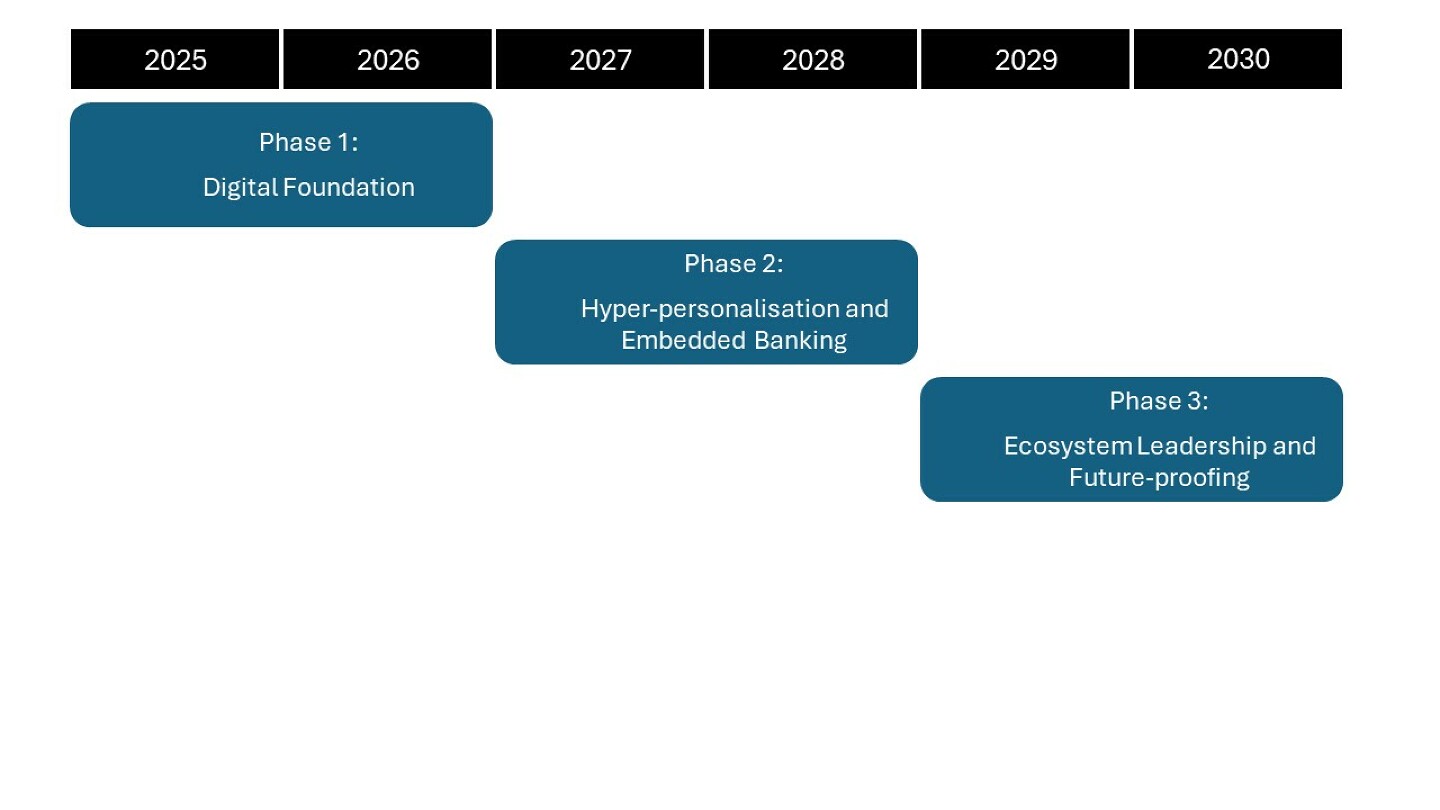
Phase 1: Building a Digital Foundation (from now)
The first phase focuses on establishing a strong digital core by modernising technology, enhancing security, and leveraging AI to improve customer experiences and operational efficiency.
This transformation will lay the groundwork for a more agile, scalable, and customer-centric bank. A key priority is modernising core banking systems by transitioning to cloud-based infrastructure and open APIs. This will enable seamless integration with fintechs, third-party service providers, and digital platforms, ensuring greater flexibility and innovation. Customer data protection and fraud prevention will be significantly strengthened through AI-driven fraud detection and advanced authentication mechanisms such as biometric verification and blockchain-based identity solutions.
To enhance personalisation, AI-powered customer insights and predictive analytics will be implemented, allowing the bank to anticipate customer needs and deliver tailored financial products and services. Real-time transaction processing will also be introduced to improve speed and efficiency in payments, lending, and other financial transactions. The mobile banking experience will be optimised with intuitive and efficient digital onboarding, self-service capabilities, and AI-driven chatbots, reducing reliance on physical branches. Additionally, an advanced CRM system will centralise customer interactions and leverage data analytics for deeper customer engagement.
Expected Outcomes
By the end of this phase, the bank will achieve higher digital adoption rates, improved security with fewer fraud-related losses, and greater operational efficiency through automation and real-time processing. Banks will achieve higher customer satisfaction due to better customer segmentation and targeting through enhanced data analytics, faster and more intuitive digital interactions.
Phase 2: Hyper-personalisation and Embedded Banking (2027 to 2028)
With a strong digital foundation in place, the next phase focuses on leveraging AI and embedded finance to provide highly personalised, intuitive banking experiences.
Customers increasingly expect services that align with their financial goals, life stages, and real-time needs. AI-driven hyper-personalisation will be expanded in lending, wealth management, and MSME banking. Machine learning will enable tailored financial advice and customised credit options based on real-time behavioural risk assessments.
A superapp, similar to Revolut's, might be introduced, integrating banking, payments, insurance, investments, and lifestyle services into a single platform, providing an all-in-one financial ecosystem. AI-powered virtual financial coaching will offer real-time budgeting tips, savings strategies, and investment insights, making banking more proactive and advisory-driven.
Partnerships in BaaS and embedded finance will deepen, integrating banking services into e-commerce platforms, fintech apps, and non-financial brands to expand customer reach.
The bank will also launch sustainability-linked financial products, including green loans, ESG reward-linked credit cards, and sustainable investment portfolios, catering to environmentally conscious consumers.
Additionally, predictive analytics will enhance customer lifecycle management, anticipating financial needs, making personalised, relevant and timely offers and improving retention.
Expected Outcomes
By the end of this phase, the bank will achieve higher customer engagement, an expanded reach through embedded finance, increased adoption of AI-driven lending and investment products, and stronger brand positioning as an innovative, customer-centric institution.
Phase 3: Ecosystem Leadership and Future-Proofing (2029 to 2030)
By this stage, the bank will evolve into a fully integrated, customer-first digital financial ecosystem.
The focus will now be on future-proofing through advanced AI, blockchain, and sustainability-driven financial solutions, ensuring long-term competitiveness.
A key priority will be to enhance customer convenience and engagement by embedding banking services into non-banking platforms, allowing customers to access financial products directly within e-commerce, travel, healthcare, and other digital ecosystems.
AI-driven dynamic pricing will enable real-time adjustments to interest rates, fees, and offers based on customer behaviour, risk, and market conditions, improving both competitiveness and profitability. To strengthen security and trust, the bank will deploy blockchain-based identity and security solutions, reducing fraud and streamlining compliance.
The expansion of ESG-linked lending and sustainability-driven finance will support climate-friendly projects, carbon credit financing, and green mortgages, reinforcing the bank's leadership in responsible banking. The bank will enhance data analytics and CRM to deliver real-time, hyper-personalised financial experiences, increasing customer loyalty and engagement.
Expected Outcomes
By 2030, the bank will achieve full digital integration with third-party platforms, higher market share through AI-driven financial products, enhanced security (perhaps via blockchain), and industry leadership in sustainable finance, ensuring long-term relevance and growth.
The C-suite's Reality Check: Why Most Traditional Banks May Struggle to Transform
Retail banks face a difficult transformation journey by 2030, with many key initiatives carrying low or medium chances of success due to legacy systems, regulatory barriers, and cultural resistance to change.
Key Challenges for Bank Executives:
- Core banking modernisation: cloud migration and open banking adoption remain high-cost, high-risk efforts. Legacy infrastructure and the risk of operational disruption make success unlikely without bold investments in technology and execution strategies;
- AI-driven personalisation: AI-powered insights and predictive analytics have moderate success potential, and real-time AI-based pricing faces execution complexity and data governance challenges, limiting its widespread implementation;
- Frictionless digital experience: superapps and intuitive and efficient onboarding may struggle due to on-going poor user experience design and slow regulatory adaptation, making them low-probability success areas in banking transformation;
- AI-human hybrid engagement: AI-assisted advisory services hold promise, yet banks currently lack a strong business case to justify the significant investment in AI needed for widespread adoption;
- Fintech and big tech partnerships: most banks view fintechs as competitors rather than partners, limiting successful long-term collaboration;
- ESG and Ethical Banking: sustainability-linked products are promising, but balancing profitability with ESG goals remains a challenge;
- Data and cybersecurity resilience: despite investments in fraud detection, banks struggle with regulatory uncertainties and execution speed, affecting cybersecurity effectiveness.
Final Warning
Without fintech-like urgency, traditional banks will not complete digital transformation and risk becoming infrastructure providers rather than customer-facing players.
Act now or lose relevance.