
Asset And Liability Management
Items to be Tracked and Decided by ALM
External Factors
Frequent analysis of key economic indicators, market trends, and the political landscape – along with their anticipated consequences – is typically presented to the ALCO in three distinct scenarios: optimistic, neutral, and pessimistic.
These interpretations enable ALCO members to assess the potential impact of each scenario on the bank's balance sheet, taking into account its businesses, portfolios, and operations. This evaluation helps in identifying the best strategic options to balance risk and profitability.
For example, if an interest rate increase is expected, how will it impact the business portfolio and customer risk profiles? What mismatches might arise between assets funded by liabilities with different term rates? How will the rate hike affect delinquency levels, and what strategies should the bank adopt to mitigate these risks? What actions should be taken to ensure financial stability and profitability?
Understanding the economy and political environment both present and future will help a bank be ready to adjust the balance sheet pricing and structure to face the foreseen challenges. It will prepare it for difficult times, creating opportunities such as how to deploy cash, investments and capital in a moment of high interest rates and an illiquid market.
Determining the minimum required return to compensate for risk is essential, as it ultimately influences pricing decisions. Additionally, during an economic slowdown, reduced liquidity can impact deposit behaviour. Individuals and companies may withdraw savings or delay investments to navigate financial challenges, altering the funding mix and potentially creating liquidity concerns.
The ability to anticipate future scenarios enables banks to better prepare for potential challenges and capitalise on emerging opportunities.
The same applies to a constant tracking of the competition, as it is important to keep and increase market share and value share. Aggressive campaigns from competitors and innovative products and services can reduce the purchase of core deposits, investments and or performing loans in a bank balance sheet.
We have many examples of such instances where competitors use pricing or special conditions to gain market and value share. For instance, Santander launched a digital bank in the United States, offering a competitive savings account yield of 5.25% to fund up to $30 billion in auto loans and expand its retail presence in the country.
In Sweden, Nordea's CEO highlighted intense price competition among Nordic banks, particularly in Sweden, as they strive for market share amid weakening loan demand. This fierce competition is causing a reduction in margins as banks aimed to attract customers in a stagnating economy.
Capital
All banks are regulated and required to keep a minimum amount of capital, normally expressed as a ratio against the total assets. The capital is the amount of money placed in the business by the shareholders, normally with voting rights. It is a collateral to protect depositors from losses. Banks hold financial reserves, bonds, and stocks that are easily convertible to cash. They also possess less liquid assets like subordinated debt, hybrid instruments, and loan-loss reserves, which can be converted to cash at a significant discount.
In a balance sheet, the capital represents the difference between a bank's assets and liabilities and serves as a safeguard against insolvency.
Each bank ideally must have capital beyond the minimum regulatory requirement. They must hold a minimum amount of capital versus the risk it will take. The higher the return, the higher the risk, therefore the higher the capital ratio.
There is a set of minimum capital requirements set by the Basel Committee on Bank Supervision (commonly referred to as Basel regulation or Basel requirement),
The Basel Accords (Basel I, II, III, and IV) establish international capital requirements for banks to ensure financial stability and resilience. The Basel III framework, which is currently in effect, introduced stricter capital requirements, which are being further refined under Basel IV. Under Basel III, banks must maintain a minimum total capital ratio of 8%, plus additional buffers.
The key capital requirements are:
Tier 1 and Tier 2 Capital Requirements
Common Equity Tier 1 (CET1) Ratio:
Minimum: 4.5% of Risk-Weighted Assets (RWA)
Consists of common shares, retained earnings, and other high-quality capital.
Tier 1 Capital Ratio:
Minimum: 6% of RWA
Includes CET1 and Additional Tier 1 (AT1) capital (e.g., preferred shares and contingent convertible bonds).
Total Capital Ratio:
Minimum: 8% of RWA
Includes Tier 1 and Tier 2 Capital, with Tier 2 consisting of subordinated debt and loan loss provisions.
Basel III Liquidity Requirements:
Liquidity Coverage Ratio (LCR)
Requires banks to hold high-quality liquid assets (HQLA) equal to at least 100% of net cash outflows over a 30-day stress period.
We will not dwell on those here. We just need to understand the importance of the capital to create a guarantee to the depositors, and that such capital has a cost, based on the shareholders' expectations, and must be considered in any pricing and business return evaluation.
How to define the required return on capital, known as the 'Cost of Capital'
The Required Return on Capital is calculated using the bank's country. It is a correlation of Government Bonds Return (normally for a ten-year bond), which in a country is the Lowest Risk Investment, plus, the difference between the stock market average share return and the Lowest Risk Return (Government Bonds), called Equity Premium and what we call Beta. Beta is the correlation of the bank share growth/return versus the overall market.
For example, if the market in a period grew 20% and the bank shares grew by 15%, the Beta is 0.75.
Cost of Capital = Lowest Risk + (Equity Premium x Beta)
For example:
Lowest Risk (Government Bond Yield): 3%
Equity Premium (Market Return – Government Bond Yield): 5%
Beta: 1.2
Calculation:
Cost of Capital=3%+(5% x 1.2)
Cost of Capital=3%+6%
Cost of Capital=9%
Thus, in this example, the Cost of Capital is 9%, meaning the company needs to generate at least a 9% return on invested capital to compensate investors for the risk taken. As we can see from the above, riskier countries will pay higher coupons on Bonds, consequently the stock market will expect to provide higher rates of return which will set a proper price for the risk involved when compared to Government Bonds. Such cost must be present in business and product returns analysis. The ALCO must track the Cost of Capital periodically.
Some companies analyse their business lines on Economic Profits, as a consideration of the Cost of Capital when evaluating a business line or product performance or making an investment decision.
Economic Profit is the Net Operating Profit After Taxes minus the Cost of Capital Charge (which is the capital invested in a business line multiplied by the Cost of Capital).
Economic Profit = NOPAT – (Capital Invested x Cost of Capital)
Where:
NOPAT = Net Operating Profit After Taxes
Capital Invested = The amount of capital allocated to a business line
Cost of Capital = The required return on the invested capital
We will talk more about Economic Profit later in the module.
How much Capital should a bank have?
The minimum capital requirement is set by the bank's regulator as a proportion of total assets. Any capital beyond this threshold supports business growth. As the business expands, asset values increase, necessitating additional capital.
However, it is crucial to avoid excessive capital holdings, as the cost of capital directly impacts the business's profitability. As previously discussed, every unit of capital comes at a cost. Therefore, when the Cost of Capital is high, it should be maintained at the minimum necessary level to support expected growth.
Any capital held by the bank is allocated across various businesses, including Commercial, Corporate, and Retail Banking. The starting point is the regulatory requirement, which is determined based on the risk classification of each asset held by the various businesses. Any surplus capital beyond regulatory requirements should be strategically allocated based on business needs, risk exposure, and expected returns.
Economic Profit
The performance of the capital allocation will be measured by business line net return. A good measure is Economic Profit (EP). A zero Economic Profit (EP) indicates that a business is generating the exact return expected by shareholders. A positive EP means the business is exceeding expectations and delivering returns above the required threshold.
A negative EP, however, does not necessarily imply that the business is unprofitable; it simply means that the return is below the minimum expected by shareholders. However, if the net return of a business is negative even before deducting the cost of capital set by shareholders, then the business is indeed unprofitable.
An important point to consider is that current EP should not be a guarantee of extra capital allocation to any business line or product. Monthly analysis of the capital risk and profitability must be done taking into consideration the trend in external factors and key sectors. Current customers and portfolios behaviours today are not a guarantee of future behaviour and tomorrow, and as noted above, ALCO must always take this into account. Do not decide on capital and funding allocation based on past analysis only!
A key recommendation when using Economic Profit (EP) to allocate capital across business units: Allocate only the capital actually utilised by the business. Regardless of whether the capital appears on the business's balance sheet, the amount of funding used to assess business returns must be adjusted by deducting the cost-free capital used to finance the business.
How do you calculate EP?
Use the following information as an example:
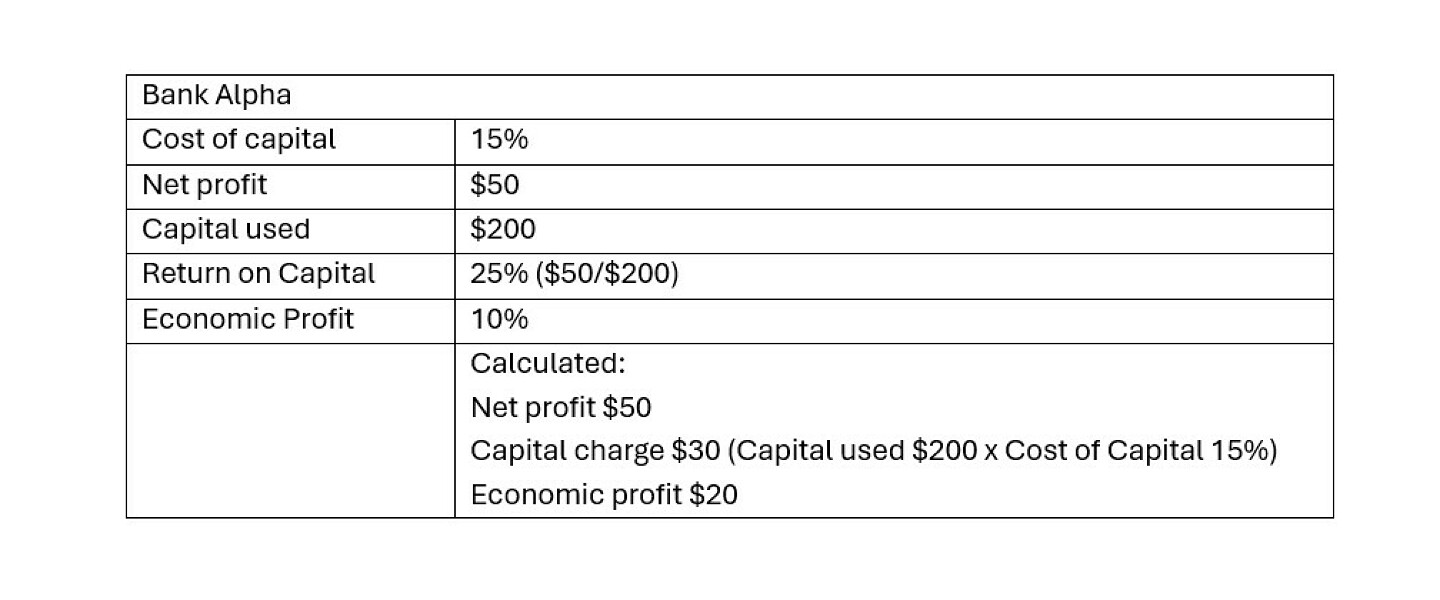
Economic Profit (EP) should not be applied without a proper understanding, as it serves as a straightforward method to ensure that capital remuneration and expected returns are always considered. However, EP is most effective in mature businesses and should not hinder growth or investment decisions. Banks and companies should not forgo opportunities solely due to EP evaluation, as it tends to penalise start-up business lines.
EP should be one of several metrics used to assess the performance of a business line, rather than the sole determinant. Economic Profit should ideally be applied to mature business lines, and ALCO should establish a clear start date for new business lines. However, banks must always consider the Cost of Capital when making strategic decisions.
As demonstrated in our example, Bank Alpha was already delivering a 25% Return on Capital, resulting in a 10% EP, indicating a return exceeding the expected Cost of Capital. A business with an EP of zero is effectively meeting capital remuneration expectations. Typically, new businesses will initially show a negative EP, as it takes time for them to mature and generate expected returns.
Dynamic of Minimum Required Capital
For a bank to operate, it must ensure it meets the minimum regulatory capital ratio. To grow, it must have capital beyond the regulated requirement, so that it can self-capitalise using excess profits to reinvest in the business as capital or seek external capital injections.
It is important to highlight that since 1988, the calculation of minimum capital required, based on Basel orientation, is a regulatory requirement. Over time new refinements on the calculation of minimum capital requirements were placed in force by Basel. As a consequence, the riskier the asset portfolio of a bank, that more capital is required, such capital requirement is also influenced, when set by the regulator with reference to the country's risk.
When calculating how much capital a bank needs, it is not only the current requirements that should be considered, but also the growth planned, as any increase in the business will likely translate into more assets and therefore more capital. A way of financing this growth is through the profit generated and retained by the business.
An example:
Required Capital Ratio: 10%
Profit of the Period: $100,000
The above profit can support an increase in Assets of $1,000,000 (if retained in the business equity and not distributed as dividends to shareholders)
Any increase above $1,000,000 will require additional capital.