
Building A Modern Customer-Centric Digital Retail Bank
Traditional Retail Banking's Inflection Point
Retail banking is approaching a critical inflection point where technology, customer expectations, innovative competitors and regulatory pressures will force traditional banks to transform or risk obsolescence. This shift will not occur simultaneously across all markets but will happen in waves, with different regions reaching their tipping points at different times.
Digital Banking Reaches a Tipping Point
Neobanks and fintechs are rapidly growing and reshaping the competitive landscape, with firms like Nubank and Revolut amassing tens of millions of customers in a relatively short time. Beyond attracting users, they are reshaping how consumers and MSMEs manage their finances, offering seamless payments, real-time transaction tracking, low-cost international transfers, and integrated personal and business financial management tools. Many users maintain accounts with both traditional and digital banks, using neobanks for daily transactions, budgeting, and short-term credit, and traditional banks for mortgages and business loans.
Around 23% of UK consumers hold a digital-only bank account, with 37% of that number opening one since 2020. By 2030, adoption is expected to rise further as digital banking becomes more integrated, potentially shifting primary banking relationships toward fintechs and neobanks. These digital challengers are gaining consumer trust and are now expanding into profitable segments, threatening traditional banks' dominance. Moreover, AI-driven personalisation and embedded finance are shifting customer expectations away from simple transactions toward intuitive, proactive financial management. Banks that fail to integrate these technologies risk losing relevance in a rapidly evolving digital economy.
Gen Z and Millennials Dominate Banking Relationships
Generation Z and Millennials are progressively becoming the dominant demographics among financial services customers and employees. According to Morgan Stanley, by 2034, Generation Z is projected to become the largest US generation, peaking at 78 million individuals.
Their preference for instant, mobile-first, and purpose-driven banking presents a challenge for traditional banks who must embrace hyper-personalisation, real-time financial guidance, and social impact banking to remain competitive. Those that fail to meet these demands will see their customer base eroded by more agile competitors who meet their preferences.
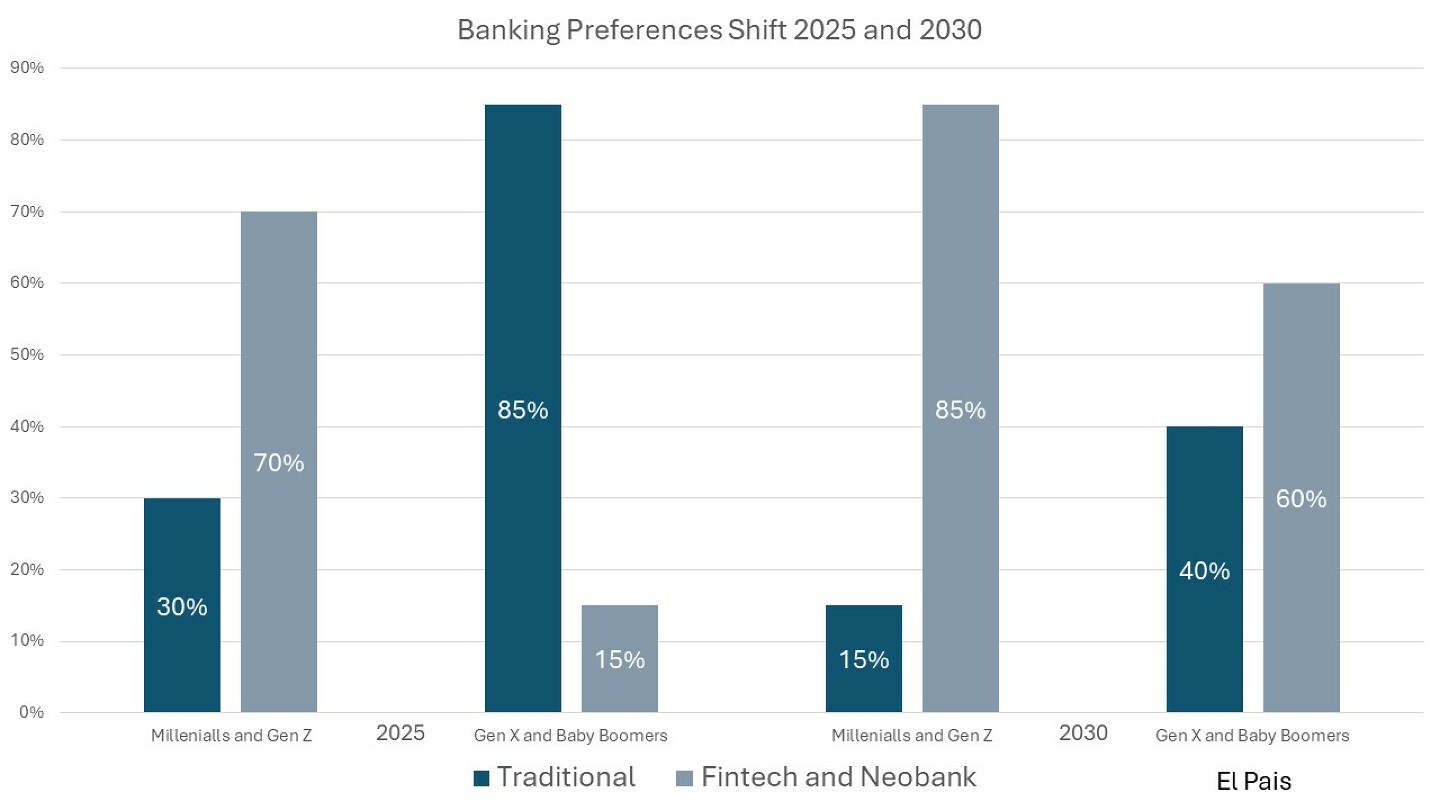
In 2025, younger generations prefer fintech and neobank solutions attracted by user-friendly interfaces, real-time services, and cost-effective offerings. Older generations maintain relationships with traditional banks, valuing established trust, comprehensive service offerings, and in-person customer support.
Looking ahead to 2030, these preferences are anticipated to shift with younger generations' preference for fintechs and neobanks services consolidating. As older generations become more familiar and comfortable with digital technologies, its anticipated that the majority will adopt fintech solutions.
Regulatory and Compliance Pressures Escalate
Regulatory shifts, including open banking frameworks, digital identity initiatives, and stricter data privacy laws, are reshaping the industry. In Europe, PSD3 implementation is expected from 2026 onwards will further advance data-sharing requirements, while Nigeria's push for open banking will drive similar transformations in Africa. Additionally, financial inclusion mandates in developing economies will compel banks to develop lower-cost, scalable service models. Adapting to these regulatory changes will be a crucial differentiator for banks
MSMEs and Women Entrepreneurs Demand Better Banking
Micro, small, and medium enterprises (MSMEs), along with women-led businesses, remain underserved despite their significant economic contributions. Banks that shift from merely offering loans to providing holistic business solutions, integrating cash flow management, credit, and marketplace tools, will unlock new revenue streams and foster deeper customer relationships. This transition from transactional banking to solution-based banking will be critical for long-term success.
AI, CRM-driven Sales and Customer Management
The future of banking lies in predictive and proactive customer engagement. AI-driven CRM systems will enable banks to anticipate customer needs and deliver next-best-action strategies at scale. However, success will depend on effectively operationalising AI, ensuring employees use these tools without overwhelming customers.
By 2030, banks must deepen their customer understanding to stay relevant. Advancements in hyper-personalisation, and real-time predictive data analytics powered by AI will drive this shift. Banks will move beyond statics segmentation to dynamic predictive insights, integrating real-time behavioural data and life-stage indicators to offer tailored financial solutions.
This transformation will shift banking from transactional services to contextual, embedded experiences. Organisations that balance automation with human empathy, mastering AI-driven personalisation and ethical data use, will become indispensable financial partners, proactively supporting customers throughout their financial journeys.
Regional Inflection Points
"The future is already here – it's just not evenly distributed." – William Gibson
In some regions the tipping point is already here:
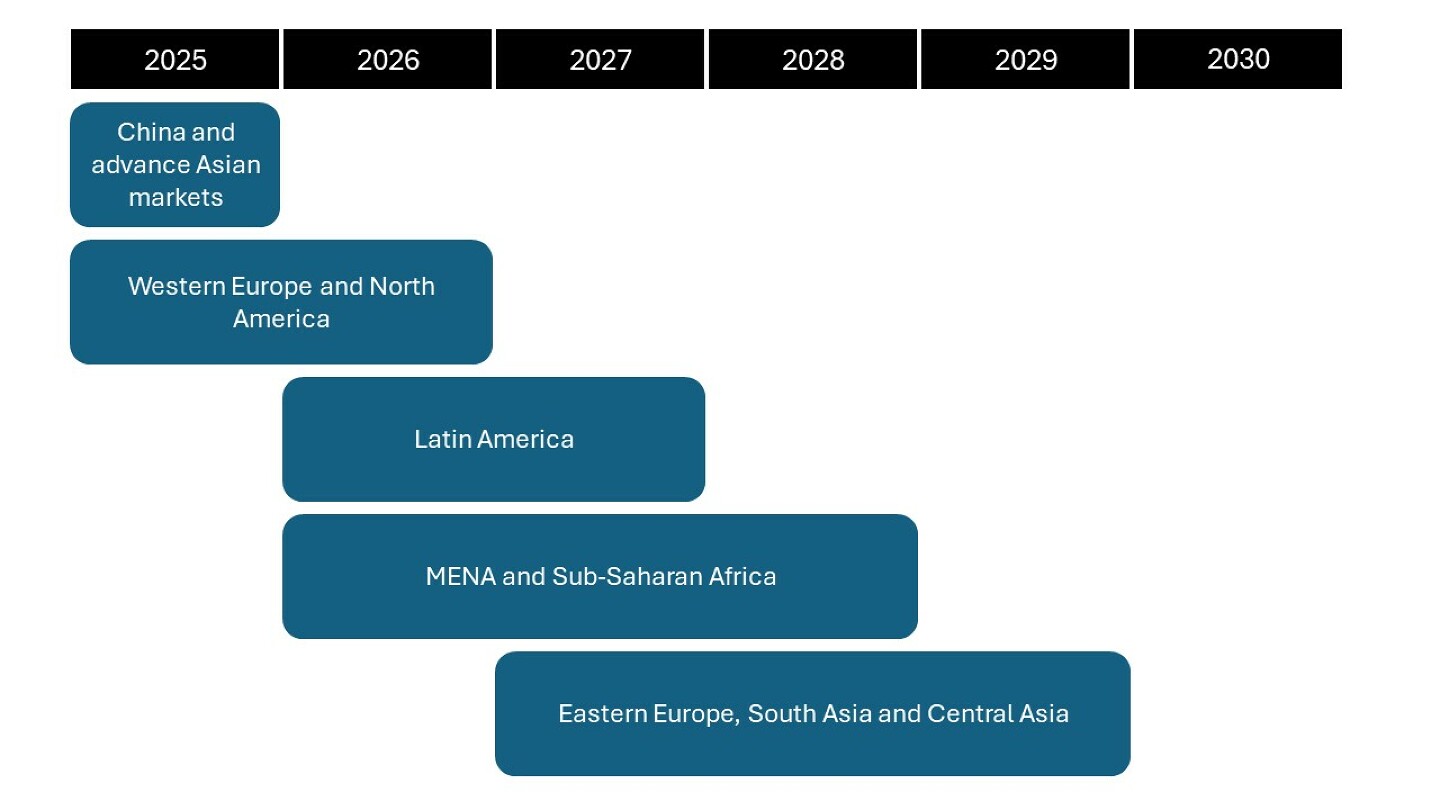
China and advanced Asian markets (2025): China is already ahead, with 'superapps' (such as WeChat Pay and Alipay) and AI-driven finance redefining the banking experience. In advanced markets like Hong Kong, Taiwan, Singapore, Australia, South Korea, and Japan, digital banking is evolving with open finance, AI-driven personalisation, and embedded banking in everyday platforms. Regulators in these regions are balancing innovation with consumer protection, while incumbents partner with fintechs to stay competitive. Superapps and digital payments are expanding, though traditional banking remains more resilient than in China due to stricter regulations and customer trust in established institutions.
Europe and North America (2025 to 2026): open banking maturity, AI-powered CRM, and rising fintech competition will drive transformation. Traditional banks will need focus on data-driven personalisation and embedded finance to maintain relevance. Big tech firms may further encroach on financial services, leveraging their ecosystems. Regulation will evolve to ensure data security and competition, while digital ID systems gain traction. Wealth management and lending will become more AI-driven, and neobanks will continue to challenge incumbents, especially among younger demographics.
Latin America (2026 to 2027): neobanks like Nubank are challenging legacy players, with digital wallets and mobile lending reshaping the market. Low financial inclusion remains a key challenge, but fintechs and telcos will expand access to banking through mobile-first solutions. Cryptocurrency and stablecoins will play a larger role in cross-border transactions due to inflation concerns and weak local currencies. Regulation will attempt to catch up with rapid fintech growth, particularly in consumer protection and digital payments. Traditional banks may have to rely on partnerships or acquisitions to remain relevant in the digital economy.
Middle East and North Africa (2026 to 2028): Gulf countries will continue leading with digital banking, AI-driven wealth management, and fintech-backed MSME financing. Governments in countries like the UAE and Saudi Arabia will push open banking and AI regulations, kick-starting innovation. In North Africa, digital wallets and neobanks will expand financial access, but regulatory barriers and cash dependence will slow transformation. Islamic finance innovations, including AI-driven Sharia-compliant solutions, will grow in prominence.
Sub-Saharan Africa (2026 to 2028): telcos and fintechs will dominate; banks must shift from branch-heavy models to embedded finance. Mobile money platforms like M-Pesa and fintech startups will continue expanding financial inclusion, offering credit, savings, and insurance to underserved populations, while banks such as TymeBank introduce new hybrid banking models. Traditional banks will need to integrate with digital ecosystems or risk losing market share. Cryptocurrency adoption will grow, especially for cross-border remittances. Regulatory challenges will persist, but governments will increasingly embrace fintech as a driver of economic development.
South Asia (2027 to 2029): India's Unified Payments Interface (UPI) and rapid fintech growth will keep it at the forefront, while AI and open banking will redefine financial services. Pakistan, Bangladesh, and Sri Lanka will see growing fintech adoption, but legacy banks will still play a dominant role due to regulatory constraints. Financial inclusion initiatives, particularly government-backed digital ID systems, will further drive digital banking penetration. Regional superapps may emerge, integrating payments, lending, and e-commerce.
Eastern Europe and Central Asia (2027 to 2029): slower regulatory adoption means banks have more time, but disruption is inevitable. Poland and the Baltic nations will lead in digital banking innovation, while others lag due to economic and regulatory uncertainty. Russian and Central Asian markets will see fintech expansion, but geopolitical factors may hinder integration with global financial ecosystems. Traditional banks in the region will rely on government backing but will eventually need to modernise as fintechs and neobanks gain ground.