
Asset And Liability Management
Key Functions of ALM
ALM Department
The ALM department in a bank has responsibility to manage and track the Balance Sheet risk and opportunities, which include risks like liquidity, funding, and FX. It needs to provide to the ALCO (we will discuss soon what the ALCO is) the elements, data, information and options to ensure the bank's liquidity, profitability, and regulatory compliance. By monitoring, analysing, and optimising the assets and liability structure, it must mitigate any risk and maintain the bank's long-term stability.
Key Functions of the ALM Department
- Liquidity Risk Management, ensuring that the bank has sufficient liquid assets to meet short-term and long-term obligations. It works with other areas and businesses of the bank to develop contingency funding plans for crises.
- Interest Rate Risk Management, monitoring the impact of interest rate fluctuations on profitability and capital consumption and requirements
- Capital and Funding Strategy, managing the balance of short-term and long-term funding sources via a vis the bank liability obligations. Ensure adequate capital buffers for regulatory capital adequacy.
- Asset Allocation and Investment Strategy, understanding the liabilities, providing guidelines on asset allocation, and ensuring the liquidity of the bank.
- ALM Modeling and Scenario Analysis, by performing stress tests and using indexes provide to the Bank's management different scenarios and implications to the bank's liquidity and profitability concerning the B/S of the bank.
- Prepare regulatory reports on capital adequacy, liquidity risk, and stress tests. Work with risk management and compliance teams to ensure adherence to financial regulations.
- Support business units in structuring products that align with ALM objectives. Assist in setting pricing strategies for loans and deposits by defining with Treasury and the ALCO, and the Transfer Pricing (we will talk about this later in the module).
The Asset and Liability Management (ALM) department is constantly tracking, building models, and making suggestions to help the ALCO manage risk, capital, liquidity, profitability and pricing in a financial institution.
The Asset and Liability Committee (ALCO)
The Asset and Liability Committee (ALCO) is accountable for the analysis of the various business performance of the business lines, their returns on capital employed, and risks, managing and arbitraging the internal pricing within a bank. It is the forum where the senior executives and those responsible for the bank will appraise and determine the various business risks and opportunities. It is normally comprised of the Heads of each line of business, the Chief Risk Officer, the CFO and the CEO. They define the overall risk appetite of the bank and how much it can grow, and the ways funding should grow.
In this module, we will discuss the main topics to be analysed by the ALCO to manage the bank assets and liabilities and the important points to be taken into consideration.
ALCO's Purpose
ALCO is the forum where the balance sheet risk, the bank portfolio profitability and resources allocation are analysed and decided.
The main goal of an ALCO is to:
- Allocate and track risks, and allocate scarce resources within the various businesses;
- Track and follow any external event that may affect the profitability and liquidity of the bank, including scenario analysis;
- Follow business performance of the business lines to maximise overall results, and oversee the transfer of value from assets and liabilities through transfer pricing and internal hedging;
- Deploy the capital available amongst the various business lines, taking into consideration the financial returns and risks.
ALCO has to evaluate the overall business risks and resources available and aims to achieve the best return with the minimum risk.
An ALCO is always learning from past market movements, clients' behaviour and the results of their strategy and interventions to improve future outcomes. It must also be 'forward-looking' and it does this by building potential economic scenarios and applying them against the current and potential growth of the various business lines, to understand how each scenario would affect each business line. This helps them adjust previous decisions and portfolio allocation every time a change or a new trend for the future is perceived.
Important items to be tracked and analysed in ALCO include:
- External factors:
- Competitor activity;
- Changes in regulations that affect the business;
- The local and global economy and its effects on:
- Price
- Employment
- Consumption
- Exchange rates
- Market liquidity (overall money available)
- The political environment:
- Level of banking regulation (if friendly to business)
- Size of the State and the consequences
- Tax level, plans and policies
We also have the following factors:
- Capital availability and allocation
- Liquidity and Funding Risk
- Interest Rate Risk
- Transfer Pricing
- Behaviouralisation
- Foreign currency risk
- Reputational risk
- Compliance risk
- Others
The focus of ALCO is to:
- Build Liquidity Ratios or methods to control Customer Liabilities to Liquid Assets,
- Measure the ratio of assets to liabilities to control loans to deposits timing,
- Look into Capital adequacy and usage in relation to risk and return, and Total Assets (further in the module we will explore it in more detail and discover why such analysis and controls are key for the bank).
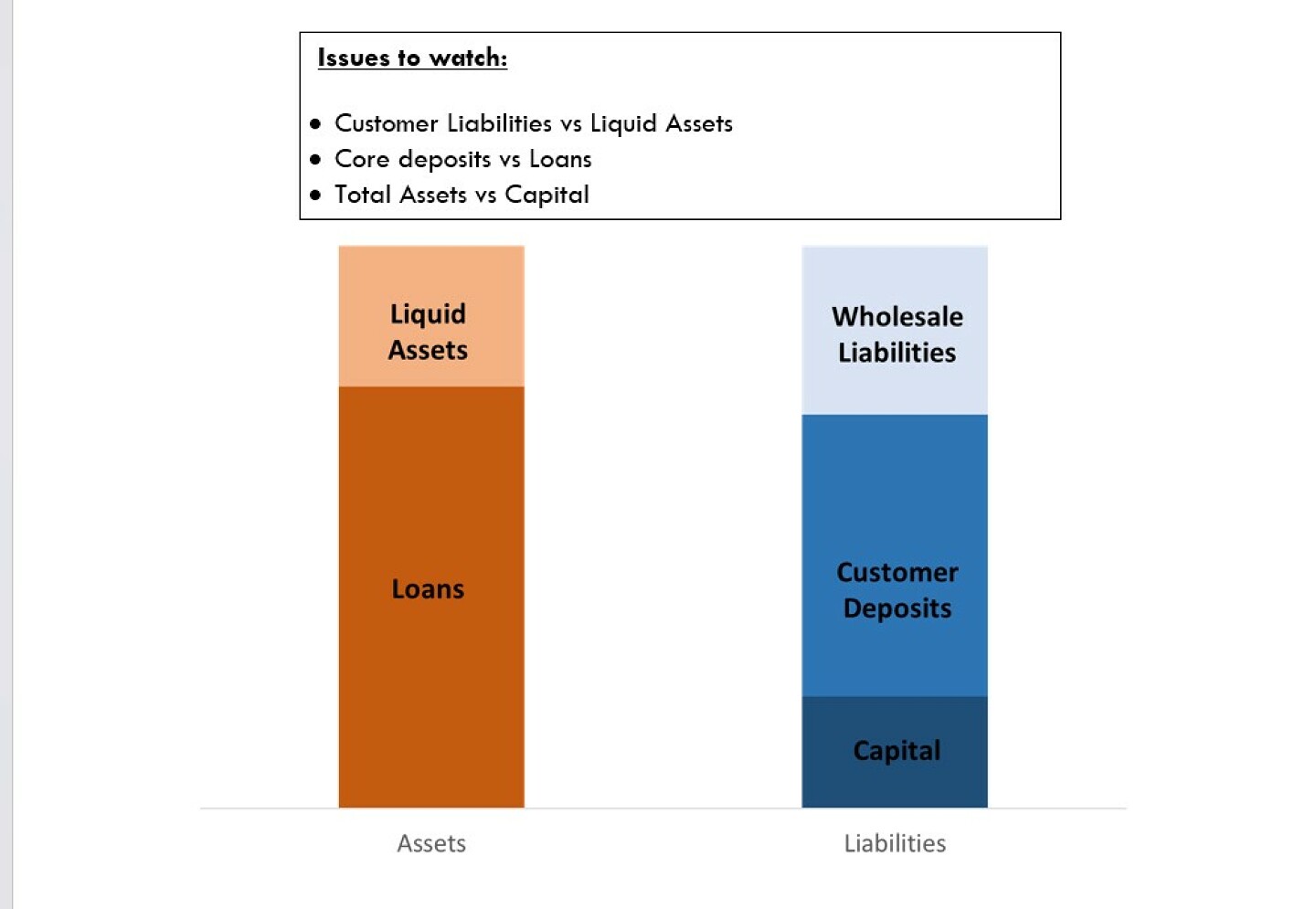
Because banks deal with other people's money, they must at all times have resources at hand whenever a client asks for their money. Bank revenues come from putting this money to work (by basically lending it) so ALCO must track the relationship between the liquidity of the assets invested (for example, in loans to customers) versus the liabilities from the market and customers, and consider how to face any mismatch. Normally a bank's liabilities are not synchronised to its assets as they have a different tenure to the assets, so ALCO must understand the size of any mismatch and be able to deal with it.
The tenure of the assets is most of the times in no synchronisation with the liabilities. To better understand this issue, imagine that a bank has $1,000 in current accounts from 10 customers (for a total of $10,000 in deposits) and lends $8,000 to a client to buy a car (an auto loan) and pay it back in 36 monthly installments. As we can see, the bank will only get the full $8,000 back in 36 months but any individual customer can ask for their $1,000 at any time.
One way to monitor it is through the Advances to Deposit Ratio (A/D ratio). This is how much of the bank's loans to its customers are covered by other customer's deposits, the volatility of such deposits, the mismatch on tenures, looking on the ability to honour deposits withdrawals, as well as and how to manage when there aren't enough core deposits to meet the loans and its implications in exposure and return.
ALCO must ensure that the bank does not breach the minimum capital requirements set by its regulator to in relation to the assets in the balance sheet and ensure that the assets provide the expected return by the shareholders within an understood and agreed risk.