
Asset And Liability Management
Liquidity and Funding Risk
Liquidity Risk
It is important to understand the importance of the liquidity risk. Banks can have losses for a period, making no profit, but survive. However, banks that have no liquidity will go bust!
A bank can face two kinds of liquidity risk: asset and liability. The first one is when an asset cannot be sold fast enough or at the expected market value due to market trading issues, such as the demand for and supply of the asset.
Liability liquidity issue is when a bank cannot meet the demands made by depositors on time and at a reasonable cost. The latter will carry an important reputational issue and can significantly increase the cost of liquidity and reduce the options available to cover such a demand.
Funding risk is when a bank does not have the source of funds to finance the loans on the book. Liquidity issues arise when a bank's asset and deposit mismatches cannot be resolved. This occurs when a significant portion of the bank's assets are illiquid while facing short-term deposit obligations. In such cases, the mismatch cannot always be covered by capital reserves or market funding sources.
This phenomenon is especially common during periods of market stress, when clients lose confidence in a bank's stability. A notable example occurred during the 2007 financial crisis, when the UK's Northern Rock experienced a bank run, leading to its nationalisation and eventual closure. Another significant case was Banco Espírito Santo (Portugal) in 2014. When undisclosed financial troubles came to light, depositors lost confidence and rushed to withdraw their funds. To stabilise the situation, regulators intervened, splitting the bank into two entities: Novo Banco ("Good Bank"), supported by capital injections to protect depositors, and a "Bad Bank", absorbing toxic assets. Despite these measures, investors lost billions, and Banco Espírito Santo ceased to exist.
It is expected that liabilities will mature before assets, which is the mismatch mentioned at the beginning of our module.
Customers deposits (and mainly retail customer deposits) stay longer and are not immediately affected by market volatility, and they are also cheaper. This is an important thing to remember when we discuss Retail Profitability and Transfer Pricing, as we will see further along in the module.
Management of the liquidity risk is about how to invest all the customers' deposits in as liquid as possible assets, while maximising the return. The ideal situation is to have all the deposits linked to assets with the same maturity, but in reality, that is not possible.
To deal with such challenges, banks run economic scenarios to understand the consequences, evaluate the potential scenarios based on past occurrences, and evaluate the bank's abilities to meet its obligations to depositors in each scenario. The last thing a bank wants is to face is a run on the bank!
Banks must be prepared to face external and internal issues that may cause unexpected withdrawals of deposits and have options to cover any shortfall at a reasonable cost, if possible.
The need for additional liquidity may come from unexpected withdrawals of deposits, loans committed drawdowns, contract terms execution before expiration, and increase of operations collaterals requirements.
To meet such demands, assets may need to be sold. To complement such sales efforts, banks have some options. Banks can use Repurchase Agreements (Repos), advance assets maturity, or use their central banks' emergency funds and cash.
Repos are when banks place mainly liquid government bonds in the overnight market to cover liquidity mismatches. However, frequent use of central bank facilities and repos can signal to the market that the bank has a liquidity issue and must be avoided.
A bank run can be triggered by mere perception. Sometimes, it takes nothing more than a casual remark from analysts at a bar who notice that Bank X is frequently relying on repos or central bank emergency funds. This observation can quickly evolve into a rumour, spreading uncertainty and sparking panic among depositors.
There are some techniques to measure liquidity, and these must be followed at ALCO to provide insights into the bank's position, such as:
Liquidity Ratios
First Line of Liquidity
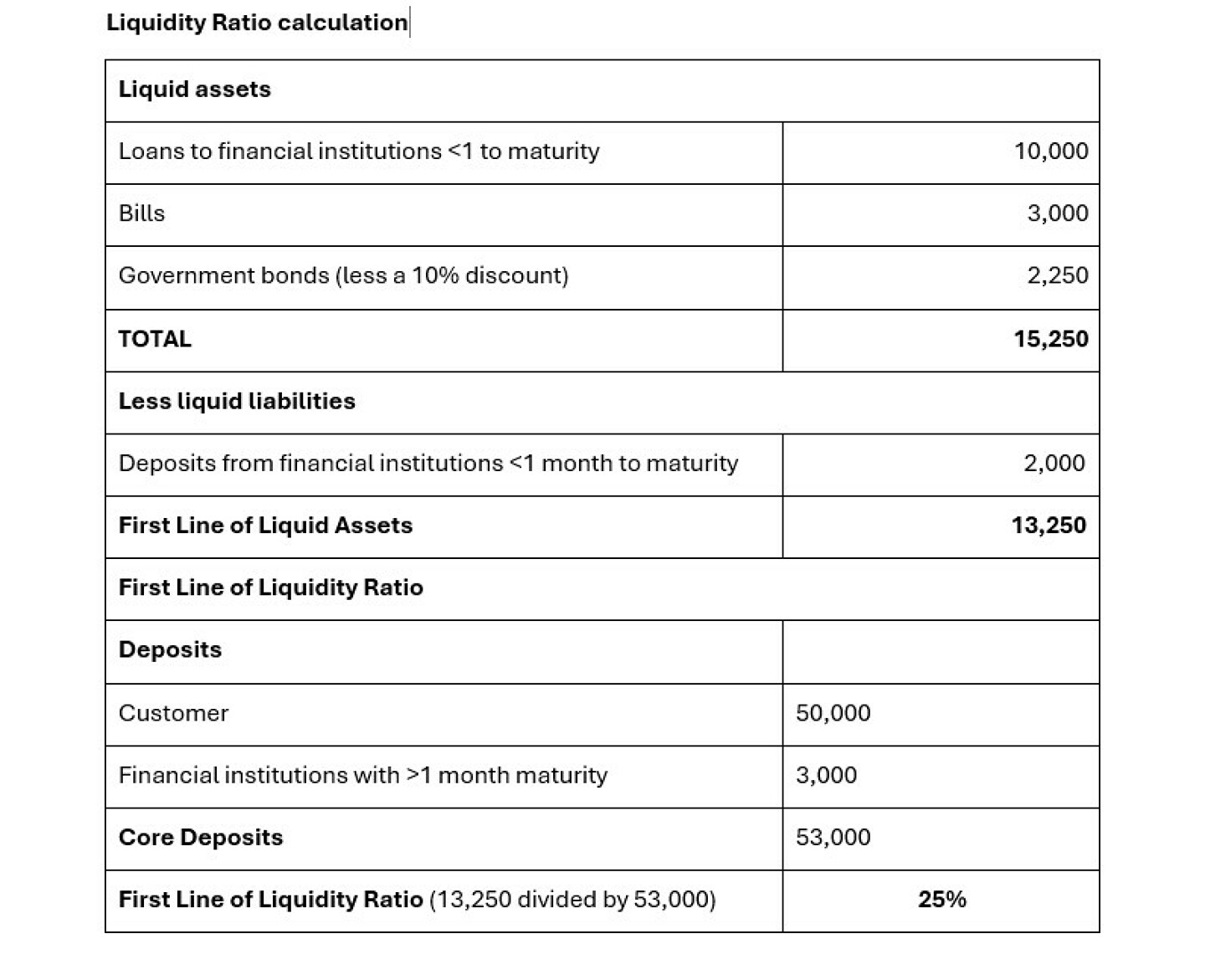
The first line of liquidity is calculated by Net Liquid Assets divided by the Core Deposits, generating a ratio, represented in a %, of the amount of net liquid assets with less than 30 days to maturity available, to cover core deposits. This ratio shows how much a bank can meet in case core deposits are withdrawn in the next 30 days and is called the First Line of Liquidity.
Banks can model other ratios for longer-term assets and name them as Second or Third Line of Liquidity according to the maturity of each one. The models must provide management with a clear understanding of how far the bank can support any level of withdrawal without reputational issues, or having to resort to financial instruments to cover the shortfall, such as repos, interbank loans, or central bank emergency funds. The more volatile a market is, the higher the risk it could use the First Line of Liquidity.
Examples of liquid assets:
- Cash held at other banks or the central bank;
- Obligations from other financial institutions with less than 30 days to maturity;
- Government Securities (with possible established discounts, normally only 10% of assets);
- AAA rated bonds from creditworthy issuers (valued with discounts).
Core Deposits
What are core deposits? They are normally the Retail deposits, which are less volatile than professional deposits from large corporate depositors, such as retailers, industries, service companies, or financial institutions as other banks, usually with a short tenure and linked to money markets, and managed by a treasury.
Retail deposits are a reliable source of funding. Again, this is another point to be used when discussing transfer pricing, which we will discuss further along in this module. Professional deposits are those managed by treasury departments of banks, funds or companies, and are not considered stable, as they will be called on maturity, or in the event of any exceptional event in the market/economy, and so are not suited as funding to long-term loans.
Liquidity Ratio Example
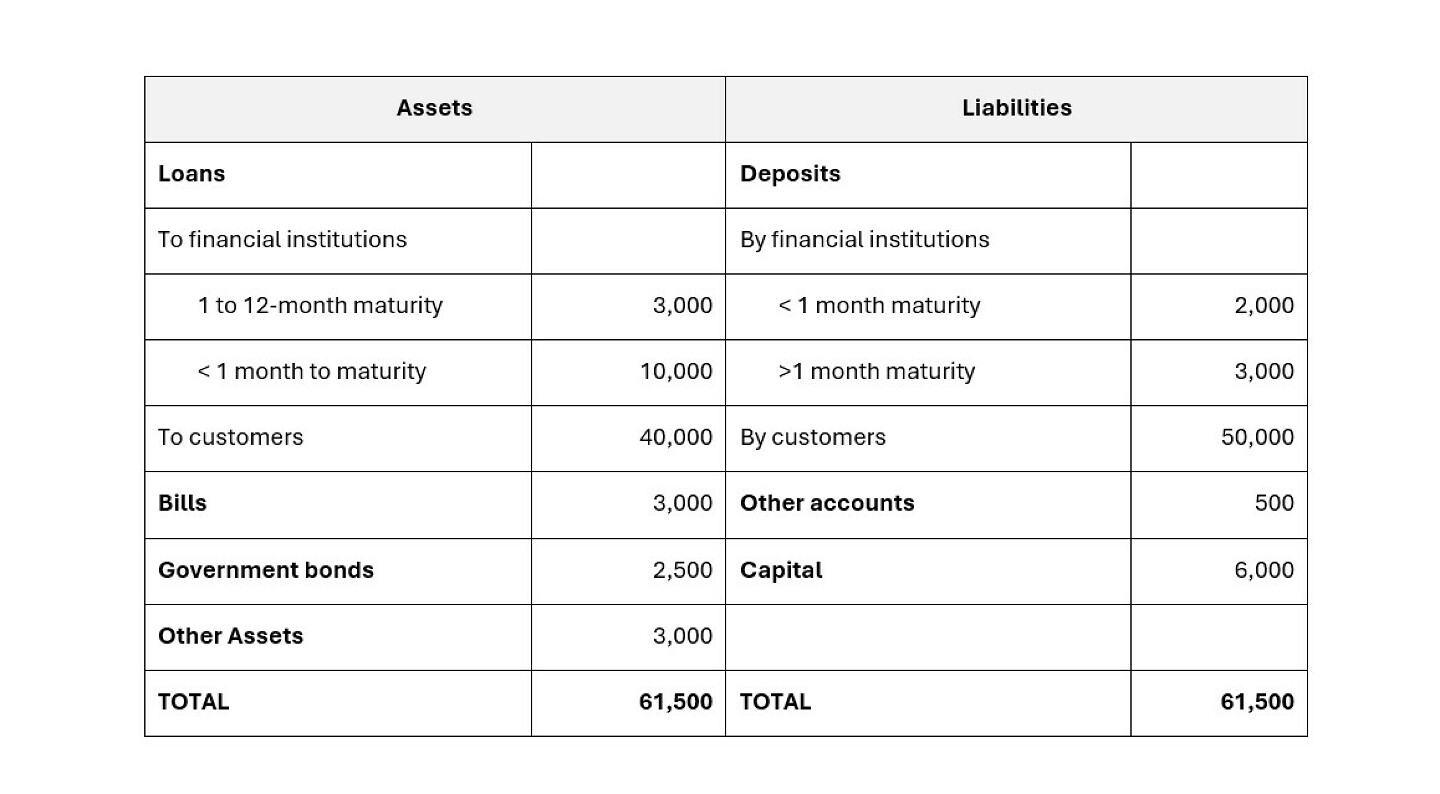
The bank has the following balance sheet:
Liquidity Ratio Calculation
Cash Flow Assessment
A bank's liquidity can be measured by cash flow assessment. Banks compare the various classes of assets versus the level of core deposit obligations, or by a cash flow assessment. Banks do a monthly analysis of the cash inflow and outflow of the institution and appraise the level of mismatch and any buffer in case of an unusual acceleration of deposits withdrawals caused by external or internal issues as mentioned previously.
The cash flow approach is more accurate than ratio analysis as it gives a time frame view of flows, it brings together all cash flows, and allows different stress scenarios to be applied. It can be used for both liquidity and funding risk.
The Concentration Issue
Another point to be taken into consideration in any Liquidity appraisal is the level of concentration of deposits. If the deposits are well spread across a wide range of depositors, the liquidity risk is lower.
Foreign Currencies Exposures
Banks that have assets and liabilities in a foreign currency on their balance sheet must perform liquidity and funding analysis in multiple currencies, looking at assets that can fund and become liquid in the currencies in question. This demands a separate liquidity and funding analysis per currency.
Funding Risk
Funding Risk arises when a bank needs to fund its assets mainly through the wholesale market, normally using professional deposits. These are more costly and more sensitive to market variations. If, within the asset portfolio, illiquid assets continue to grow, it increases the potential mismatch between assets and liability maturities.
Banks must identify how prepared they are to fund their asset growth with professional funding. They should also establish a cap on how much they will rely on the debt market to fund their loans. To minimise the funding risk, on top of looking for customer deposits, and avoiding professional lines, a bank must diversify its funding sources using:
- Retail products
- Commercial and /Corporate banking products
- Debt Markets
- Interbank Products
- Financing Programs
- Bonds
The best way to minimise the funding risk is to track the Advances to Deposit Ratio and establish their ideal level. Restrict sources to advance other than core deposits, as it is the most reliable source of funding. Many banks explicitly say that the preferred way to fund loans across the bank is via Retail customer deposits, which is important in the discussion of transfer pricing across the bank.
Loans growth through wholesale (Large-scale borrowing from financial markets, other banks, or institutional investors) and non-bank professional deposits (Deposits from entities that are not traditional retail customers, such as large corporations, investment funds, or other financial institutions) should be avoided.
Advances to Deposits Ratio Example
Using the same bank balance sheet:
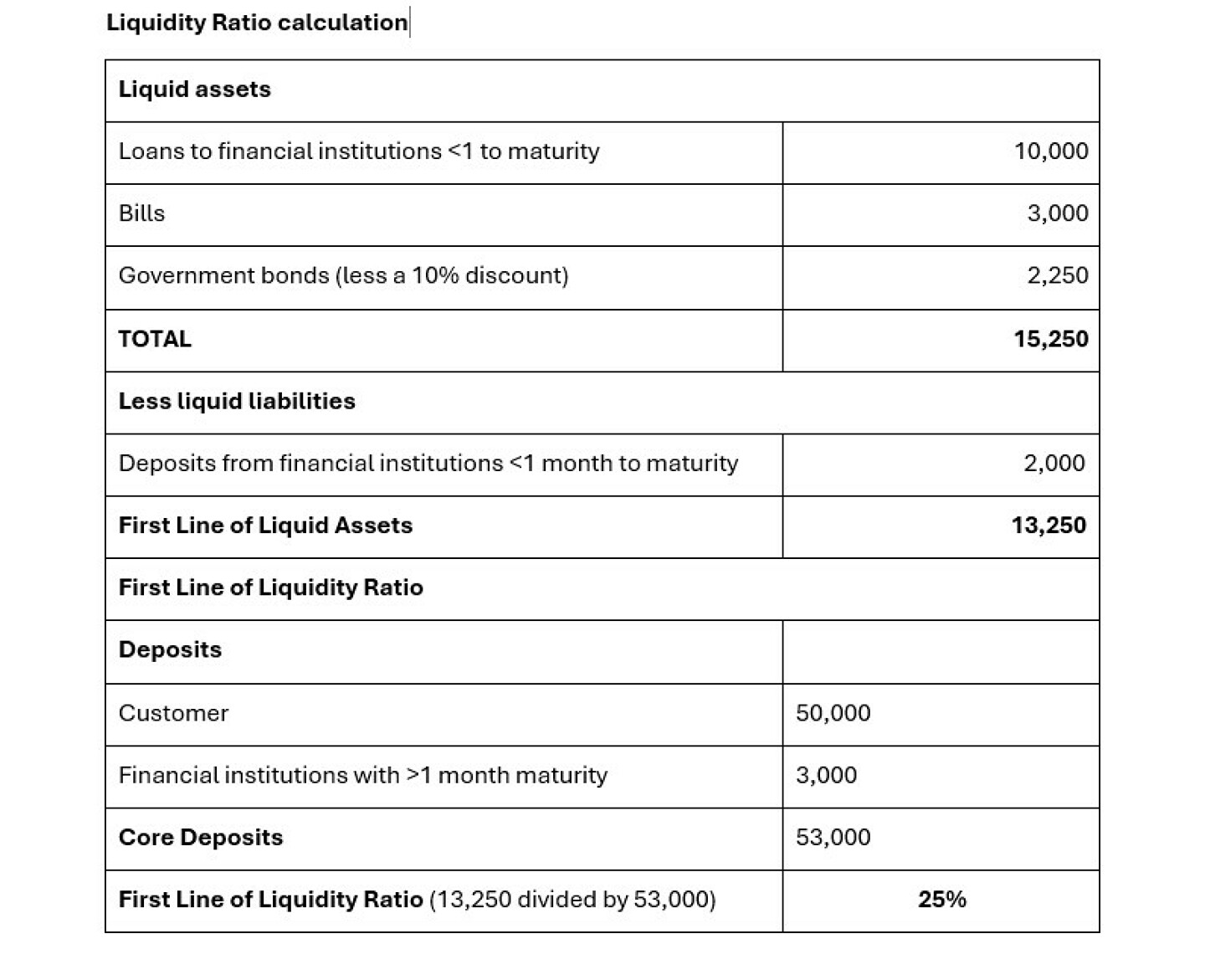
Advances to Deposits ratio (A/D Ratio) Calculation
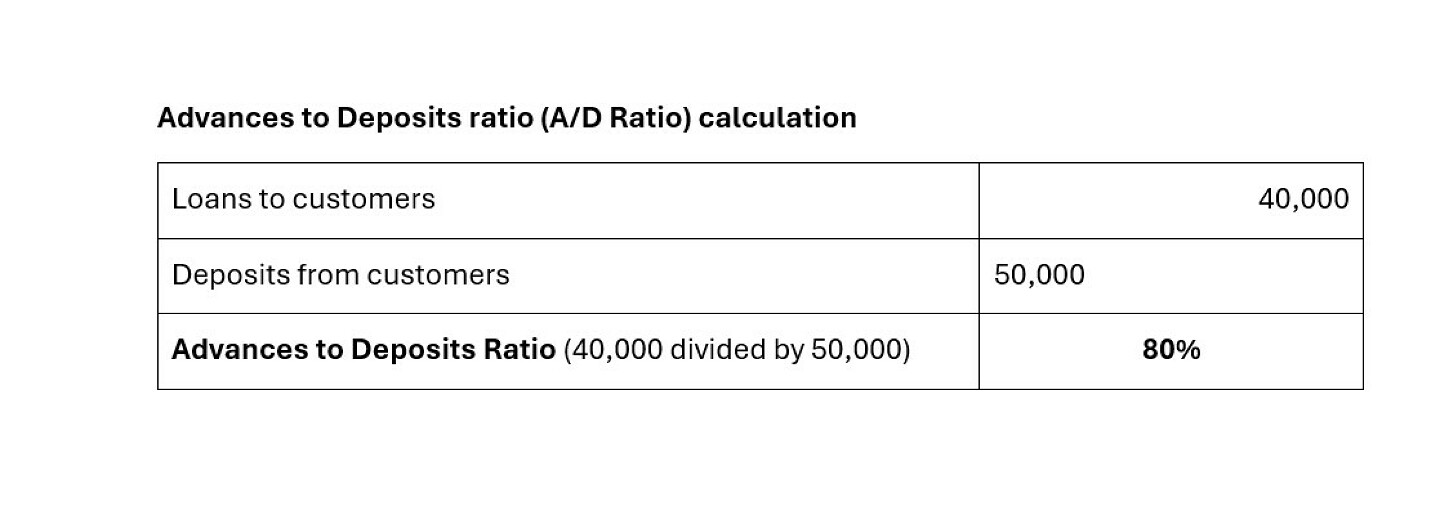
In the above example, the bank has an A/D ratio of 80% which is seen as a conservative approach, where the Loans are funded exclusively by customer deposits. This is in essence a low funding risk. The bank is not resorting to any other less stable and more expensive funding resource like wholesale funding, market-based funding, and capital instruments.
Each bank will set a different A/D ratio target, depending on market liquidity, central bank funding rules, and how easily loans are sold or securitised. So, for the loan book growth, a bank will require capital and funding to grow, preferably based on core deposits.
When a bank does a loan portfolio securitisation, it is increasing its capital requirements and increasing the resources to fund new loans.
What is a Loan Portfolio Securitisation?
It is a financial process where a bank transforms a pool of illiquid loans (such as mortgages, auto loans, or credit card receivables) into tradable securities. These securities are then sold to investors, transferring the associated risk, unlocking liquidity and lowering the capital requirement of the bank.
As we have discussed, banks are required by regulators, to hold capital based on their Risk Weighted Assets. When a loan portfolio is securitised and sold, they are removed from the bank's balance sheet (totally or partially, depending on the terms of the transaction – if no collateral is given, totally), such removal, will lower the bank's minimum required capital. Freeing capital for new loans.
At the same time by "selling" the loan portfolio, it increases the bank's liquidity, and funding capacity, as a result of the cash inflows from the transaction. Such money can be used to fund new loans, or to fund any other project or bank obligation.
A detailed analysis is required to understand the parameters behind each loan portfolio in terms of maturity, risk, price and securitisation. Such analysis will highlight any mismatch between the assets and liabilities involved and help to build options in the case of stress or the need to free funding on core deposits in the future.
With a liquidity or funding issue, ALCO must deal with the situation based on an analysis of scenarios and past experiences. There are many triggers to alert ALCO, all based on funding deterioration in volume or price, unexpected reduction of core deposits, spread of credit increasing, difficulty with the commercial papers secondary market, or fraud.
We have classic examples of banks that have faced a bank run based on major fraud cases. One such case Banco Ambrosiano in Italy in 1982, a case involving the mafia and the Vatican, a fraud scandal of US$1.3 billion. Banco Ambrosiano, one of Italy's largest private banks, engaged in fraudulent offshore lending and had secret ties with the Vatican Bank. It used shell companies to launder money for the mafia and finance illegal activities. As a result, over $1.3 billion in unsecured loans were missing from its books. When the fraud was exposed, depositors panicked and rushed to withdraw their funds.
Another classic example is the Barings Bank from the UK in 1995. Nick Leeson, a trader at Barings Bank in Singapore, secretly made risky derivatives trades and hid massive losses in an unauthorised account. The total losses exceeded $1.4 billion, wiping out the bank's entire capital. Senior management was unaware of the true risks due to lack of oversight and internal controls.
When the scandal broke, confidence in Barings collapsed overnight. Customers and investors rushed to withdraw funds, and the UK government refused to bail out the bank. Barings Bank collapsed in 1995, and it was sold to ING for £1 (one British pound).
Any liquidity issue must be treated with discretion. The bank should look for solutions that will not trigger suspicion in the market, as when such news spreads many sources of liquidity will dry up, and the risk of a bank run increases as the issues continue.