
AI, Mobile Money and the Future of Banking
AI and the future of finance
One of the biggest stories in a year of big AI stories is the decision by the US hyperscalers to “slow the pace of progress”. But not everyone believes that they have been overwhelmed by their concerns for the safety of humanity. The arrival of Chinese AI models such as DeepSeek and more recently Kimi K3 from Moonshot AI challenges the accepted wisdom that people and businesses need hyper-scalable data centres to run their AI models. Instead, it’s now possible to run a variety of models on on-premises infrastructure at a much lower cost, while keeping all of the data private – which is crucial for organisations such as banks.
That means a combination of local servers and data centres can provide all the computing power necessary to advance AI into financial services. That’s very important in the context of places where the ratio of people to data centres is low, such as Africa (0.9 data centres per million people), Asia (0.30) and Latin America (0.9) vs the US at 9.5 data centres per million people.
So this week we take a look at two South African players that are deeply invested in AI and data analytics. One is a telco that wants to develop a mobile money-based superapp. The other is a bank that wants to become a ‘super bank’.
MTN’s infrastructure play
While it’s South African banks that helped to finance the initial building of data centres in Africa, Africa’s telcos may be major investors in and users of new AI data centre infrastructure. Africa’s MTN has spoken lately of pushing deeper into the building and use of AI data centres, and it’s also speaking about driving deeper into financial services, including applying for bank licences.
With new laws around data localisation in many African countries, Africa’s telcos look most likely to blend AI and mobile money into powerful new offerings in financial services. Earlier this year, South Africa’s MTN announced plans to support the creation of a new network of AI-enabled data centres across its African markets, part of a shift away from reliance on US and EU-based data centres that currently host most of Africa’s data and data services via subsea cables.
Bankers in Africa, who have been collaborating to provide funds to mobile money players, are increasingly watchful of the power of the telcos. “They are holding customer deposits, paying interest on deposits, and lending to their customers,” one banker told Lafferty Group recently. “They could be bigger than banks in a few years’ time.”
In some ways, telcos are already bigger than many banks because of their multi-country reach. MTN was the top African-origin brand in 2026, at number 11, according to Brand Africa with Vodafone at 19, Airtel at 27 and Orange at 49. Phone makers Samsung, Apple and Tecno – at 3, 4, and 13 – were also among the top brands in Africa. No bank cracked the top 100, though it’s worth noting that the Brand Africa survey tends to rewards aspirational brands that are top of mind, and most people regard their bank as utilitarian rather than aspirational.
Why mobile money wallets work
Telco wallets have become a destination for deposits that once went to banks and stayed there. Many bank customers receive salaries into their bank accounts, and then move that money into popular mobile money apps or digital wallets where they can send and receive payments to a wide network, pay bills, shop in stores and online, and quickly apply for and take out loans. While banks would prefer customers to use bank wallets, mobile money wallets tend to create bigger networks than bank wallets from individual banks.
In Ghana, MTN’s MoMo is now synonymous with mobile money, with close to 80 per cent of that market. MTN Ghana’s profits after tax for the first half of this year were just north of 5 billion Cedis, while few individual Ghanaian banks earned profits over one billion Cedis in the same period. In Nigeria, meanwhile, MTN has just crossed the 100 million customer mark in a country of 242 million people.
All those mobile money transactions give telcos pools of transaction data that they can then use to offer further services. While banks are rich in financial risk data such as income, card spending and repayment histories, the telcos have huge pools of behavioural data from everyday spending, which are the data suited to feeding into AI-driven lending decisions.
MTN and banking licenses
In recent years, there’s been a trend in Africa towards three-way partnerships between banks (providing the capital), telcos (providing the customers and platform), and AI-powered credit analytics fintechs doing the credit risk analysis to enable fast processing of loans. It appears that telcos may be planning to move faster with AI-powered operations than banks.
MTN CEO Ralph Mupita said recently the business is looking at acquiring banking licences, as part of its wider three-pronged approach of connectivity, fintech and infrastructure. “The big growth now, which will be the growth of the future, is actually lending,” he told Reuters. (MTN currently does lending in partnership with banks.) “We're beginning to explore, where it makes sense and where there are large customer bases (and) significant floats in wallets, whether it may make sense to have some sort of banking licence that enables us to take deposits,” he said. “As such, we will then be lending over time off our own balance sheet.”
MTN says it will be a minority investor in AI-enabled data centres for African markets, partnering with Gulf-based developers and initially targeting the Nigerian and South African markets. With developments towards data sovereignty and locally hosted data, this is a canny move by the telco. Mazen Mroue, CEO of MTN Digital Infrastructure, said earlier this year that the company is investing in ‘Sovereign AI’ across the continent. (That doesn’t mean the US is giving up its ambitions for Africa, by the way. When Huawei bid in August to build data centres in Egypt, the US government encouraged US companies to put together a counteroffer.)
Is the smartphone the new branch?
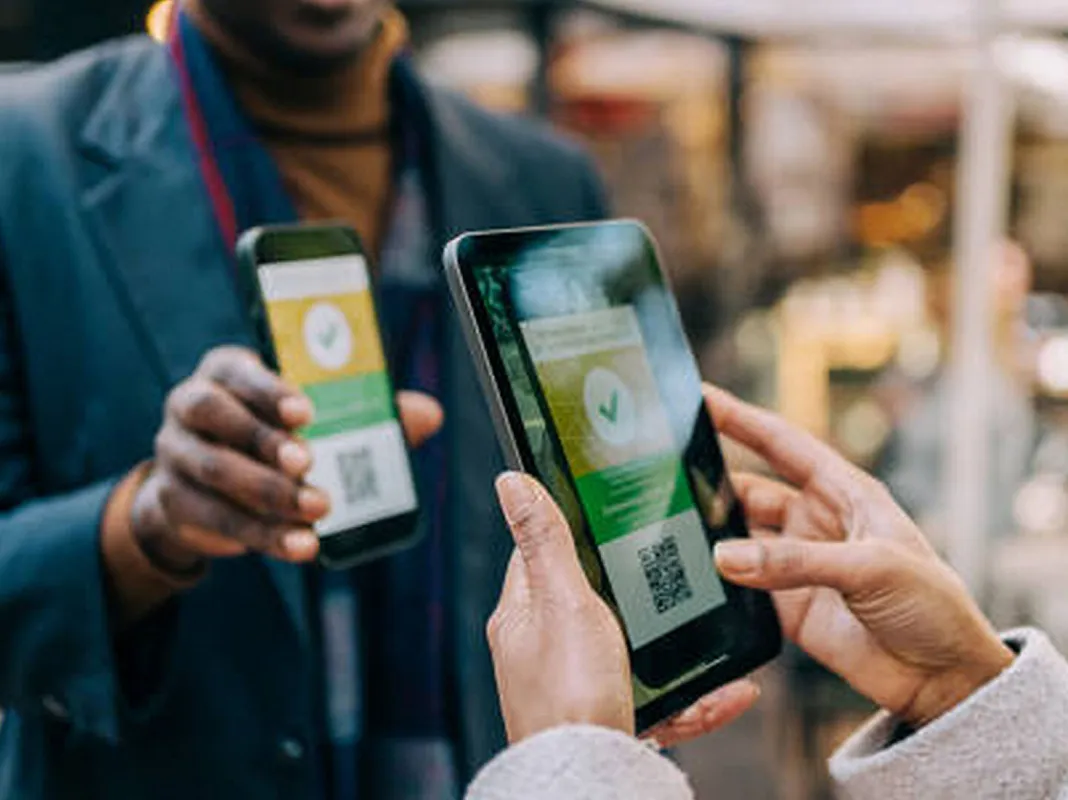
The telcos see major potential in the upgrade to smartphones and increasing use of apps for financial services, as the mobile phone becomes the principal interface for financial services. They also know they’ll have to improve networks and service for that to happen.
Few banks don’t offer apps to their customers, but telcos have a uniquely close and symbiotic relationship with mobile phones. The newest generation of phones are AI-enabled, with neural engines on the phones which can be combined with in-cloud processing for heavier tasks – including all of the biometric security features. The GSMA argues that smartphones will unlock far greater mobile money potential than feature phones. The smartphone is arguably becoming what the bank branch was in the last century – the place where people store their money, do transactions, and receive financial advice.
What comes with a banking license – and should banks be worried?
Should banks be worried about telcos moving into lending? While MTN – and its telco competitors – may have the data and the customer base to start lending off its own balance sheet with a banking licence, becoming a standalone bank is far from straightforward. It’s not clear what type of bank MTN would create, though it’s likely to be a digital and branchless bank, and a business ringfenced from the telco business. (Regulators in Nigeria for instance have not yet issued standalone new digital bank licenses.)
Then there’s the regulations and competencies around banking that MTN does not currently have. Banks have capital requirements, which have been raised recently in Nigeria, and are being raised elsewhere, encouraging consolidation. Then there’s the liquidity and asset and liability management requirements that are core to retail banking. When lending comes onto the balance sheet, there’s a whole new set of requirements including provisioning models, and portfolio limits – though it’s unlikely that telcos will be offering mortgages anytime soon. MTN however has partnered with Ant International, which has long specialised in super-apps that platform merchants. With other banks focused on superapps, such as Revolut, lending is a much smaller part of their business than it is at traditional banks, which are known as … lenders.
MTN no doubt already realises that the reasons it is more agile than banks – including operating under e-money institution or payments licences – disappear once it starts to operate under the much stricter regulatory supervision regimes that apply to banks.
The Super Bank
There’s an illustrative contrast to MTN, and it’s a relatively new South African bank. Discovery Bank wants to become a Super Bank rather than a super app, and in many ways it’s focused on lifestyle as much as finance. Like the telco’s mobile money businesses, it’s heavily invested in AI processes and behavioural data, though it comes from a different expertise and a difference source.
Discovery Bank emerged from Discovery Group, an insurance-centred business that since the 1990s has been a user of behavioural data to encourage its customers towards a healthier lifestyle. In recent years it has built an impressive AI stack (and US companies are in the mix). In collaboration with Databricks (and its Azure Databricks platform), Discovery’s data science team turns behavioural data into data products that get reused across pricing, risk, personalization, service and fraud detection. Those products then feed into its Next Best Action decisions.
Its Vitality Money programme – developed with Google Cloud – tracks key financial behaviours (including for instance savings and retirement contributions) and offers rewards based on good behaviour. This manifests as lower fees or higher interest rates on savings. Discovery’s long track record in harvesting behavioural data to create what it calls shared value for its clients has proving well suited to the age of AI and digital banking. (Incidentally, “creating shared value” is one of MTN’s strategic ambitions for 2030.)
Many banks have announced their ambitions to be super apps – think of Revolut, DBS’s Digibank or Nubank. Discovery has taken the super out of super app and attached it to ‘bank’. Search for “Super Bank” on the internet and it will lead you to Discovery Bank.
The Lifestyle Business
There’s no doubt that banks would love to provide the daily transactions that are now mostly in the domain of mobile money wallets in Africa. But should they aim at becoming superapps?
As banknote printer and security business Giesecke + Devrient argues, there’s a difference between superapps and banks: it can be summed up as convenience vs trust.
“The superapps model works for non-financial institutions because convenience is their most important currency,” says Bart Vullings, Senior Product Manager, G+D Netcetera. “For banks, it is trust – and once you lose it, it’s hard to get back. That’s why every expansion decision must be carefully weighed not just against revenue potential, but against any potential risks.”
A decade ago, banks worried about social media companies coming for their businesses. In the intervening years, social media aka big tech players with their vast expertise in data and analytics have pivoted towards the AI business.
So the telco + AI model is worth watching. With AI-on-smartphones at the user end and AI-enabled data centres on the production end, the gathering and analysis of behavioural data will only grow. The question is how far AI and behavioural data will go towards earning customer trust that people will be comfortable making big decisions through a mobile phone.
One twenty something explained it this way: They and their friends are happy to book an airline ticket online. They notice that older people prefer to order such tickets on a desktop or laptop, not quite trusting themselves on a mobile. Does that ring true for you?
Lafferty Group
Contact Us
enquiries@lafferty.com
caroline.hastings@lafferty.com
The Leeson Enterprise Centre
Altamont Street
Westport, Co. Mayo
Ireland
F28 ET85